Cool comfort, same day, no surprises
An air conditioning repair service in Savannah, GA keeps homes cool through the long coastal summer, and our seasoned technicians handle everything from a frozen coil to a full compressor failure. We serve the Historic District, Ardsley Park, Southside, and out to The Landings on Skidaway Island with same-day and 24/7 emergency response. Every diagnosis is quoted as an honest ballpark on the phone, then confirmed exactly before any work begins, so there is no surprise number when the work is done.
Tell us about your air conditioning repair service job — we'll get you a fast quote.
A firm, all-in price confirmed before we start — no surprises.
On time, done to standard, and tidy when we leave.
Reach a real Savannah air conditioning repair service technician to describe the problem — no call-center runaround.
We look at the actual system and explain what is going on before any work.
You get the price for the fix up front and decide before we proceed.
Serving Savannah and the surrounding area — confirm coverage by phone.
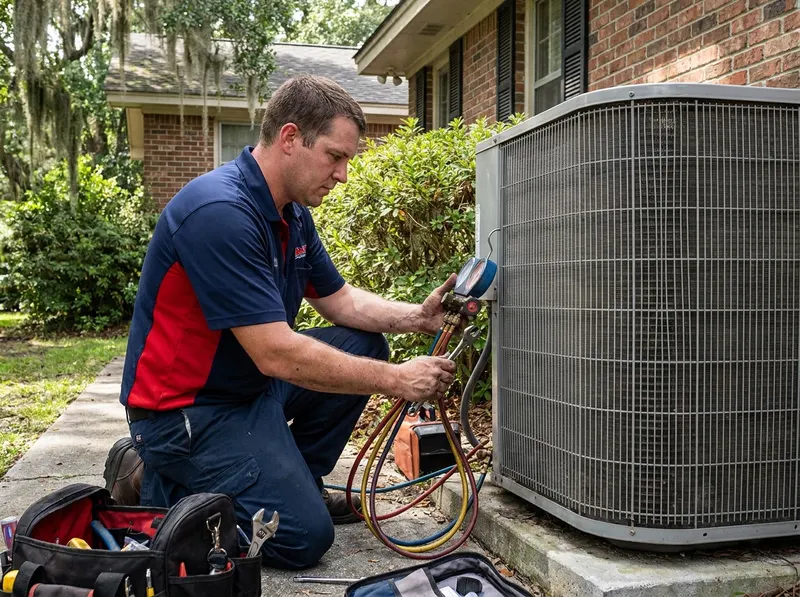
Emergency AC repair makes sense when the system has failed and waiting is not comfortable or safe — a warm-air blower on a 95-degree Chatham County afternoon, a unit that trips the breaker every time it starts, or an indoor coil freezing over and dripping. If the system is still cooling but running poorly, a standard scheduled repair or a tune-up is usually the better-value choice, since emergency response prioritizes speed over the flexibility of picking a convenient window. The trade-off is straightforward: emergency service moves faster, while a planned visit gives more room to compare options.
Older homes around Ardsley Park and Thomas Square often run into emergency failures tied to aging capacitors, contactors, and condensate lines that clog in Savannah's heavy humidity. In Starland District and Baldwin Park, second-story bedrooms over a shaded street can feel the loss of cooling quickly once a compressor or fan motor quits. Homes near the water in Isle of Hope, Georgetown, and The Landings on Skidaway Island deal with salt-air corrosion on outdoor condenser components, which can shorten the life of contactors and coils and lead to sudden no-cool calls.
A typical emergency visit starts with a symptom check: is the outdoor unit running, is the indoor blower moving air, and is the breaker holding. From there the technician isolates the fault — electrical, refrigerant, airflow, or drainage — and explains what the fix involves before any work begins. In Parkside, Gordonston, and across the Southside, the most common summer emergencies are failed run capacitors, seized fan motors, tripped safety switches from a flooded drain pan, and low refrigerant from a leak. When a part is common and on the truck, the repair often happens the same visit.
Some failures are not worth an emergency repair. If a compressor has failed on a system that is more than a decade old, patching it quickly may cost more than it returns, and a replacement conversation makes more sense. Emergency AC repair in the Savannah area is best used to restore cooling fast and to buy time for a calm, informed decision when a larger fix is on the table.
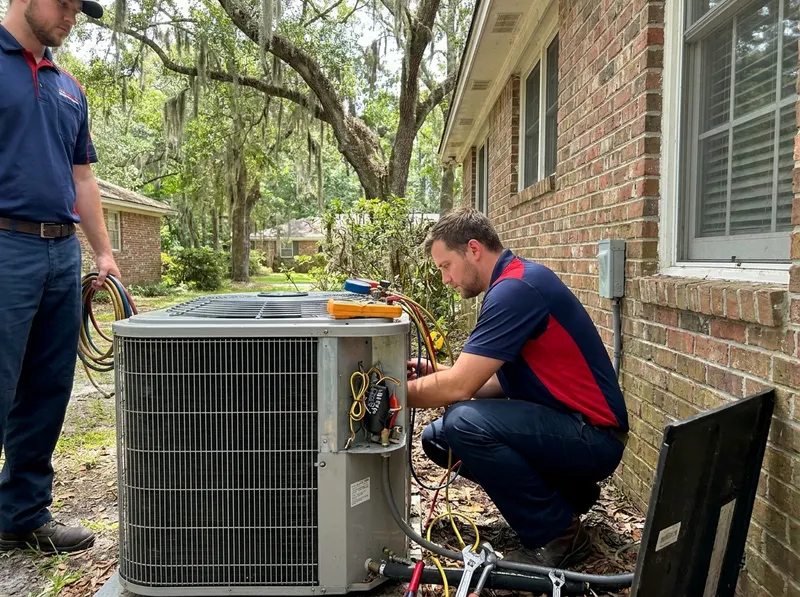
A central AC system in Savannah works harder than most because the cooling season runs long and the coastal air stays heavy. In older homes around Ardsley Park and Gordonston, the original ductwork often predates the current condenser, so a repair visit checks whether weak airflow is a failing blower motor or a duct restriction before any part gets replaced. In newer builds across Baldwin Park, Parkside, and Southside subdivisions, the more common central AC faults are failed run capacitors, tripped contactors, and refrigerant leaks at the line-set connections.
Central air conditioner repair is the right call when your whole house cools unevenly, the outdoor unit hums but the fan won't spin, or warm air blows from every vent at once — signs the shared system, not one room, has a problem. If instead a single room stays hot while the rest of the house is fine, the issue is usually airflow or duct-related rather than a system failure. The trade-off with central repair is that fixing an aging system component can be worthwhile short-term, but a unit past its service life may need repeated repairs; a technician on-site can tell you which of those you're facing.
Savannah's humidity puts extra load on the condensate drain, and a slow clog is one of the most frequent shutdown causes in homes near Isle of Hope and The Landings on Skidaway Island, where salt air and moisture accelerate corrosion on outdoor coils. Systems in the Starland District and Thomas Square, often retrofitted into historic structures, can have tight equipment closets and unusual duct runs, so the diagnostic step matters more here than a quick guess. Homes in Georgetown on the south side tend to have straightforward slab or attic air handlers that are quicker to access.
Every visit begins with a diagnostic so the actual fault is confirmed, not assumed. The $150 minimum covers the trip and diagnosis; the repair total depends on the part and labor, and that figure is given to you before the work starts. This keeps the pricing honest — a ballpark up front, an exact number confirmed at your home.
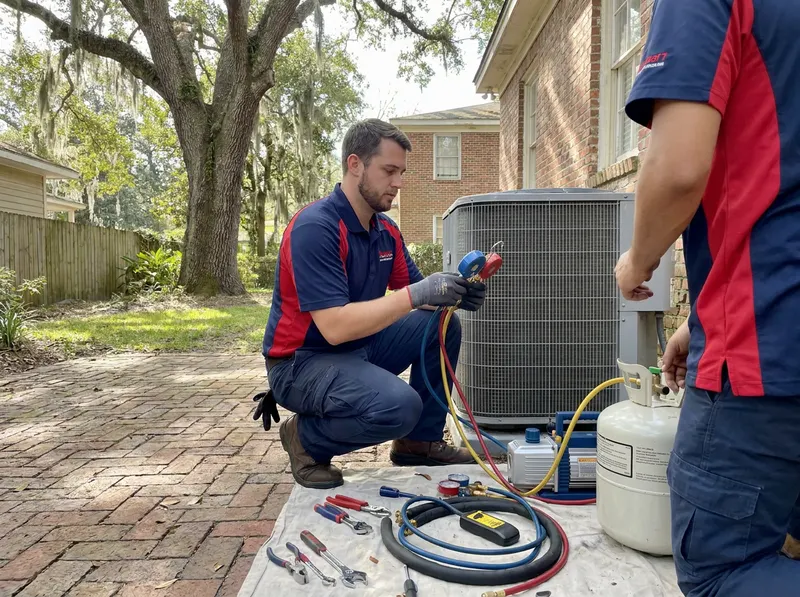
A refrigerant leak shows up before you see the puddle. Warm air from the vents, ice on the copper lines, and a system that runs constantly without cooling are the common signs Savannah homeowners notice first, often during a humid July stretch when the unit never catches up. Low refrigerant forces the compressor to work harder, so a small leak left unaddressed can become an expensive compressor failure. Fixing the leak first protects the most costly part of the system.
Leak repair is the right call when the system still cools but loses performance over weeks or a season, and when the coil, line set, or fittings are otherwise sound. If the evaporator coil is heavily corroded or the unit is well past its service life, replacing the coil or the system can be the better long-term value than repeatedly repairing an aging coil. We locate the leak with electronic detectors or UV dye, then give you the honest trade-off before any work begins. Older R-22 systems common in longer-established Ardsley Park and Gordonston homes cost more to recharge because that refrigerant is phased out, which sometimes tips the decision toward replacement.
Savannah's coastal air is hard on condenser coils. Homes near the marsh in Isle of Hope and on Skidaway Island at The Landings see salt-air corrosion pit the aluminum and copper faster than inland Southside or Parkside properties, and that corrosion is a frequent source of slow refrigerant leaks. In the Starland District and Thomas Square, retrofitted systems in older bungalows often develop leaks at line-set joints where fittings have loosened over time. We check the vulnerable points for your specific setup rather than guessing.
After the repair, we pull a vacuum on the system to remove moisture and air, then recharge by weight to the manufacturer's spec so the unit runs at the efficiency it was designed for. An accurate charge matters in this climate: an overcharged or undercharged system in Savannah's heat cools poorly and drives up the power bill. We serve Baldwin Park, Georgetown, and the rest of Chatham County, and every job starts with a clear look at whether repair or replacement serves you best.
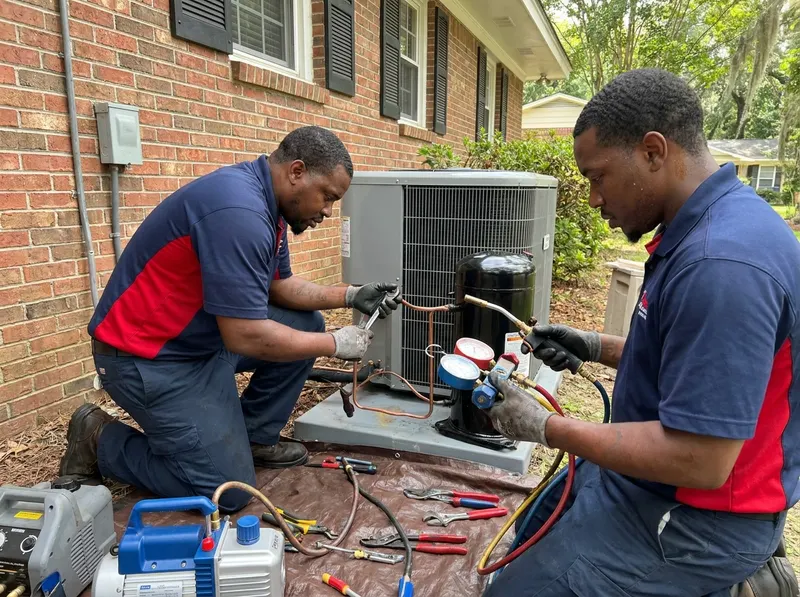
A compressor rarely fails without warning signs. Savannah homeowners usually notice the outdoor unit humming but not starting, a hard-tripping breaker, warm air from every vent, or a loud clicking as the compressor tries and fails to kick on. The first job on any compressor call is separating a true compressor failure from cheaper culprits — a bad start capacitor, a failed contactor, or low refrigerant from a leak elsewhere. Many calls that sound like "the compressor is dead" turn out to be a $150-range electrical fix, which is why the diagnostic comes before any big quote.
Repair fits when the compressor is mechanically sound but a supporting part has failed — capacitors, contactors, hard-start kits, and wiring are all repairable without touching the compressor itself. Replacement is the right call when the compressor is seized, shorted internally, or has burned out, and it becomes the smarter economic choice on older systems. In Savannah's salt-air zones — Isle of Hope, The Landings on Skidaway Island, and homes near the marshes off Georgetown — corroded condenser coils and electrical contacts wear compressors faster than inland Southside or Baldwin Park units, so age and location both factor into the repair-versus-replace decision.
Savannah's climate is hard on compressors. Long summers, high humidity off the Wilmington and Skidaway Rivers, and units that run near-continuously from May through September push compressors to their limits. Older bungalows in Ardsley Park, Thomas Square, and the Starland District often pair aging condensers with undersized or corroded electrical components, which stresses the compressor over time. In Parkside and Gordonston, we frequently find units short-cycling because of a failing contactor rather than the compressor — an important distinction, since replacing a compressor that didn't need replacing is the most expensive mistake a homeowner can make.
When a compressor genuinely needs replacing, refrigerant type matters. Systems using older R-22 refrigerant may cost more to service or make full-system replacement the better value, and that trade-off is explained plainly on-site before any decision. Every quote is a ballpark until the unit is inspected — the free on-site visit confirms the exact cause, the exact part, and the honest cost, so there are no surprises after the work begins.
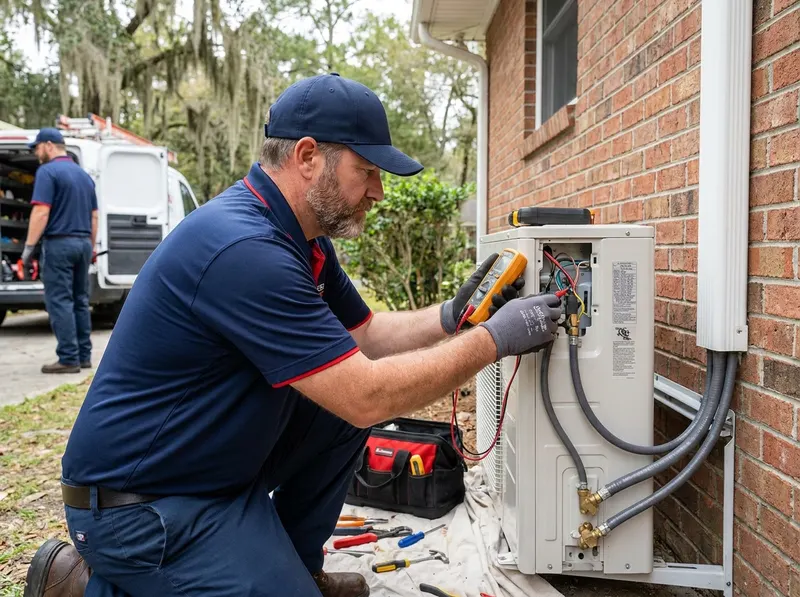
Mini-splits behave differently from central AC, so the fix is different too. When an indoor head in a Starland District bungalow blows warm air but the outdoor unit hums, the problem is usually low refrigerant, a failed reversing valve, or a communication fault between the head and condenser — not a clogged duct, because there are no ducts. We read the unit's error code first, then confirm it with gauge and voltage readings rather than guessing at parts. That matters most on multi-zone setups in larger Ardsley Park and Gordonston homes, where one weak head can point back to a shared outdoor board rather than the head itself.
The most common Savannah mini-split call is water dripping from the indoor head onto the wall or floor. In our humid coastal climate, the condensate drain line clogs with biofilm fast, and gravity-drain runs in raised Isle of Hope and Baldwin Park houses are especially prone to slow flow. Clearing the line and flushing the pan often solves it without any part replacement. If the head is icing over instead of leaking, that usually signals low refrigerant or restricted airflow across the coil, and we test for a leak before adding refrigerant so the charge does not simply escape again.
Ductless repair fits well when the failure is isolated to a specific zone, when the equipment is under roughly ten years old, or when a single head or the outdoor fan motor is the culprit. Repair usually beats replacement in those cases. Replacement becomes the smarter call when a compressor has failed on an older single-zone unit — at that point the part-plus-labor cost approaches a new system, and a new unit resets the warranty. We give you the honest comparison on-site so the decision is yours.
We service mini-splits throughout the area, from converted historic units near Forsyth Park and Thomas Square to newer garage-conversion and addition installs in Parkside, Southside, Georgetown, and The Landings on Skidaway Island. Salt air off the marsh corrodes outdoor coils and fan motors faster here than inland, so coastal Chatham County systems benefit from catching small faults early. Exact repair cost is confirmed after the on-site diagnosis; the numbers below are ballparks.
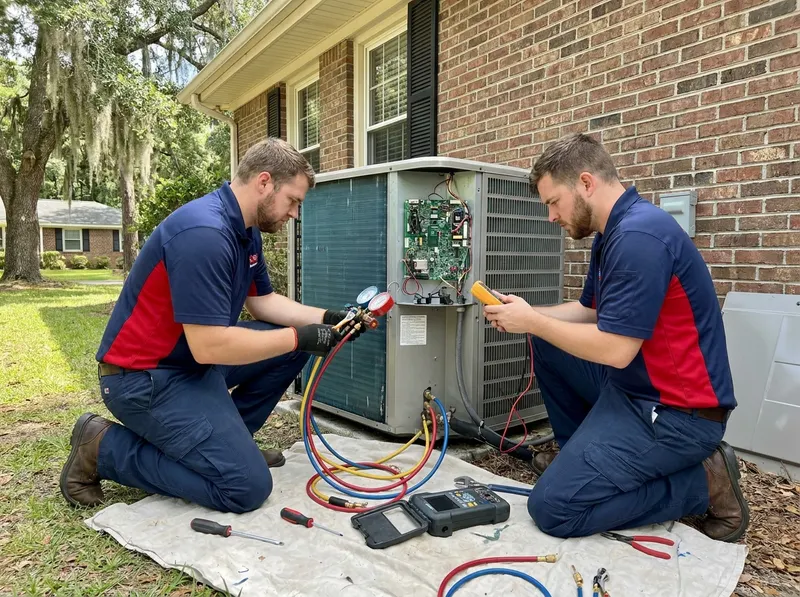
A heat pump differs from a straight air conditioner because it reverses to provide heat, and that reversing valve is one of the parts that most often fails on older Savannah units. When a heat pump blows cool air in cooling mode but warm air won't switch, the reversing valve or its solenoid is a likely cause. When the outdoor unit ices over on a rare cold Chatham County morning, the defrost board or sensor is usually the culprit. A proper repair identifies which of these is actually failing rather than replacing parts by guesswork.
Heat pump repair makes sense when the unit is generally sound and the failure is isolated — a bad capacitor, a stuck contactor, a low refrigerant charge from a small leak, or a fan motor. Repair is the right call for the many mid-life systems across Ardsley Park, Thomas Square, and Baldwin Park where a single component has failed. Replacement becomes the better economic choice when a compressor fails on a system that is already a decade or more old, or when the same unit needs repeated refrigerant top-offs. On a free on-site visit the failing part is identified and the repair-versus-replace trade-off is explained honestly before any work begins.
Savannah's coastal humidity is hard on outdoor heat pump condensers. Salt-carrying air near Isle of Hope, The Landings on Skidaway Island, and other water-adjacent addresses corrodes coils and electrical contacts faster than inland locations, so contactor pitting and coil corrosion show up here more often. Shaded, tree-heavy blocks in Gordonston and Parkside also collect leaf debris in the outdoor unit that restricts airflow and mimics a refrigerant problem. Homes in the Starland District and Georgetown that run their systems nearly year-round put steady wear on capacitors and blower motors. These local conditions shape what a Savannah heat pump repair actually finds.
Every repair starts with a real diagnostic: measuring refrigerant pressures, testing the reversing valve and defrost cycle, and checking electrical components under load. The findings and the price are presented before the work happens, so there are no surprises. Southside and downtown Historic District homes are all served, and the minimum charge for a visit is $150.
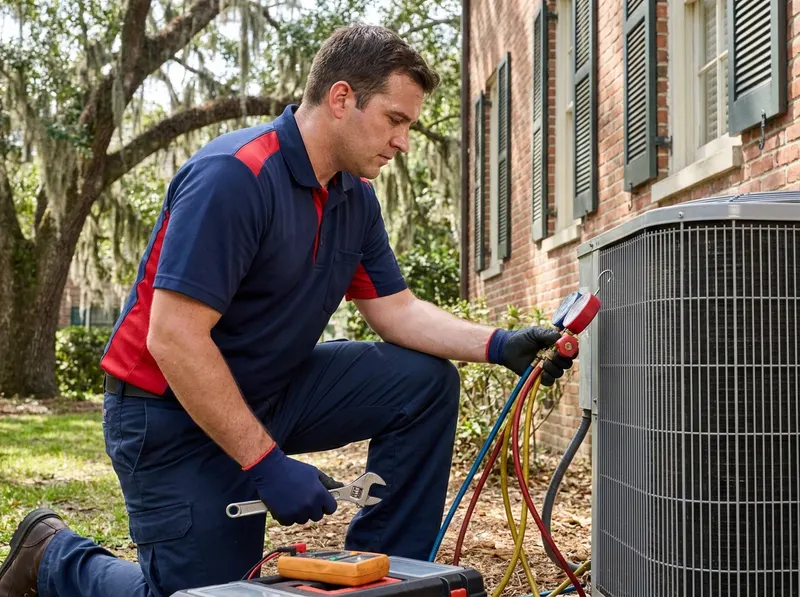
Savannah's climate is the main reason AC maintenance matters here more than in drier regions. High humidity off the Wilmington and Skidaway rivers keeps evaporator coils damp, which encourages mold growth and clogged condensate drains. A tune-up clears that drain line and cleans the coil so the system dehumidifies properly instead of leaving rooms clammy. Homes near Isle of Hope and The Landings on Skidaway Island sit close enough to marsh air that outdoor condenser coils collect salt film and organic debris faster, so a maintenance visit that includes a condenser rinse pays off.
A tune-up fits best when your system still cools but you want to prevent a mid-July breakdown, lower your power bill, or protect a manufacturer warranty that requires annual service. It is the alternative to waiting for a repair call during peak season, when demand is highest and a failed compressor costs far more than a cleaning would have. If your unit is already blowing warm air, tripping the breaker, or leaking water, that is a diagnostic and repair situation rather than routine maintenance — the trade-off is that a tune-up is preventive, not a fix for an active fault.
Older homes in the Savannah Historic District, Ardsley Park, and Thomas Square often run ductwork and equipment that benefit from yearly attention because tight retrofits and long duct runs stress the blower. Newer builds in Baldwin Park, Parkside, and around Southside still accumulate dust and pollen that reduce airflow across the coil. Spring, before the Chatham County heat settles in, is the ideal window to schedule; booking then avoids the summer backlog and gets your system ready for the stretch when it runs hardest.
Maintenance is straightforward and honest: the ballpark ranges below cover typical Savannah single-family systems, and the exact price is confirmed on-site once a technician sees your equipment and access. The minimum charge for a maintenance visit is $150. Multi-system homes and units in tight or elevated locations may fall at the higher end of the range.
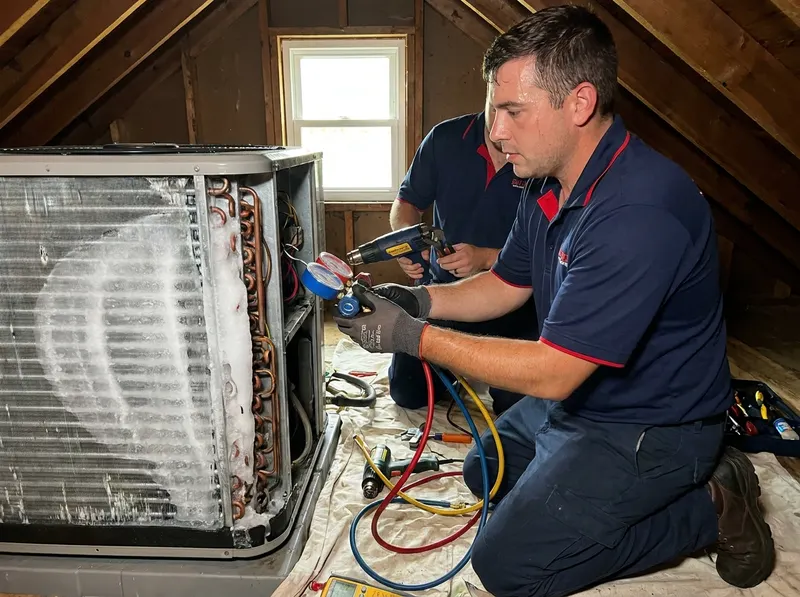
A frozen evaporator coil is a symptom, not a cause, and the repair is only lasting when the reason behind the ice is identified first. In Savannah the two most common triggers are restricted airflow from a clogged filter or blower issue, and a low refrigerant charge caused by a leak. High summer humidity along the coast makes a third cause frequent here: a clogged condensate drain that backs up and contributes to freezing, especially in older systems around the Historic District and Thomas Square where drain lines are long and shallow. We check all three rather than guessing.
The repair sequence matters. The coil must fully thaw before it can be inspected or the system safely restarted, so we typically turn the unit to fan-only or shut it down, then return or wait to complete the fix. Attic air handlers common in Ardsley Park and Baldwin Park bungalows freeze quietly and drip through ceilings, so we also verify the drain pan and secondary line while we are there. For homes in The Landings on Skidaway Island and Isle of Hope with larger multi-zone systems, we confirm each zone's airflow because one closed-off area can freeze a shared coil.
Frozen coil repair fits when the ice keeps returning after you change the filter and let it thaw, or when you notice weak airflow, water around the indoor unit, or higher runtimes. If the coil itself is corroded and leaking refrigerant, coil replacement rather than repair is the honest recommendation, and we will explain the trade-off and cost before any work. A simple airflow fix costs far less than a refrigerant-leak repair, so pinpointing the cause is what determines the price. For Southside, Georgetown, and Parkside homes with heat pumps, we also confirm the freeze is not a winter defrost-cycle issue before treating it as a summer cooling fault.
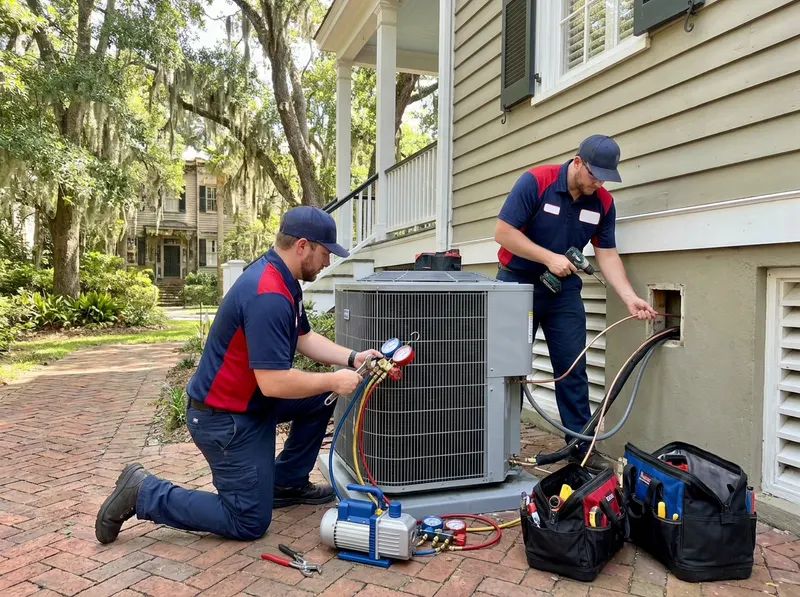
Replacement makes sense when a system is beyond economical repair, when repair costs approach half the price of a new unit, or when an aging condenser can no longer keep up with Savannah's long, humid cooling season. If your equipment is under about ten years old and the failure is a single component, a targeted repair is usually the smarter spend. The honest trade-off: repair buys time on aging equipment, while replacement resets your reliability and cuts the summer electric bills that older, low-efficiency units drive up. We walk through both paths before you decide.
Correct sizing matters more than brand. An oversized unit short-cycles and leaves the air clammy, which is a real problem in humidity-heavy pockets like Isle of Hope and The Landings on Skidaway Island, where moisture control is as important as raw cooling. An undersized unit runs constantly and never catches up during a July afternoon. We measure the load rather than guess, and we inspect existing ductwork because a new system tied to leaky or undersized ducts underperforms from day one.
Home age shapes the job. Older masonry and frame homes in the Savannah Historic District, Ardsley Park, Thomas Square, and Gordonston often have tight mechanical spaces, original ductwork, or window and wall units that need a thoughtful transition to central air. Newer construction in Southside, Parkside, and Baldwin Park usually allows a cleaner like-for-like swap. In Starland District and Georgetown we regularly plan around limited attic and closet access, which affects the equipment we recommend and how the install is staged.
Every replacement starts with a free on-site visit so the quote reflects your actual home, not a phone guess. Coastal salt air near the marshes and waterways of Chatham County can be hard on outdoor condensers, so we discuss placement and protection where it matters. You get a written estimate with the equipment, scope, and range spelled out before any work begins.
If your AC is under about 10 years old and the repair is a capacitor, contactor, or refrigerant leak, choose a repair — it is the lower-cost path and buys years of service. If the system is 12 to 15 years old, uses discontinued R-22 refrigerant, and the compressor has failed, replacement usually makes more financial sense than sinking money into an aging unit. If you run a heat pump and want lower year-round energy bills in Savannah's mild winters, a heat pump replacement pays back faster than a straight AC swap because it heats and cools from one system. If your home has no ductwork — common in older Thomas Square and Historic District houses — a ductless mini-split repair or install fits better than fighting to retrofit ducts through plaster walls. The trade-off is upfront cost versus long-term efficiency: repairs are cheap now but a dying system fails again, while replacement costs more today and cuts monthly bills for a decade. A repair keeps cash in your pocket this month; a replacement trades a bigger check now for a quieter, more efficient system that dehumidifies better in coastal air. We tell you honestly which side of that line your system sits on during the on-site visit, and the $150 diagnostic applies whether you repair or replace.
| Service call & diagnostic (minimum) | $150 |
| Capacitor replacement | $150–$300 |
| Contactor replacement | $150–$350 |
| Refrigerant leak repair & recharge | $300–$1,200 |
| Blower motor replacement | $400–$850 |
| Condenser fan motor replacement | $350–$700 |
| Frozen coil diagnosis & repair | $150–$600 |
| Condensate drain clearing | $150–$300 |
| Thermostat replacement | $150–$400 |
| Reversing valve repair (heat pump) | $600–$1,500 |
| Compressor replacement | $1,200–$2,800 |
| Spring AC tune-up | $150–$250 |
| Mini-split repair | $150–$700 |
| Evaporator or condenser coil replacement | $800–$2,500 |
| System replacement / new install | quoted on-site |
Call for a firm, all-in price before any work begins.
We give an upfront, written price before any work begins — you approve it first. No surprises.
Our work is done to standard and we stand behind it — a real fix, not a quick patch.
We’ll give you an honest assessment. If you don’t need the work, we’ll tell you.
Savannah's coastal humidity is the hidden reason AC systems here fail sooner than the national average — salt air off the marshes near Isle of Hope and Wormsloe Historic Site corrodes outdoor condenser coils, and the constant dehumidification load runs compressors hard from late May through September. Older homes around Ardsley Park and the Historic District often have undersized or aging ductwork that chokes airflow and freezes coils, and many of those Thomas Square and Starland District houses were built long before central air, so they rely on retrofit systems or ductless mini-splits squeezed into tight spaces. Newer Southside and Landings on Skidaway Island houses tend to have the opposite problem — oversized units that short-cycle and leave the air clammy because they never run long enough to pull moisture out. Condensate drains clog faster in this climate too, since warm humid air feeds algae growth in the drain line, and a backed-up drain is one of the most common reasons a Savannah system trips off in the middle of summer. The heavy pollen from Forsyth Park's oaks and the tree canopy across Gordonston and Baldwin Park cakes onto condenser coils each spring, cutting efficiency before the season even starts. We factor those real local conditions — salt corrosion, humidity load, pollen buildup, and drain fungus — into every diagnosis instead of quoting a generic fix, because a repair that ignores why the part failed just fails again by August.